Turning Homework Time Into Learning Time: A Practical Guide for Parents at Marton Primary
For many families across the UK, the after-school hours can feel like a second shift. Bags are dropped, snacks are demanded, and then comes the moment that tests even the most patient of parents: homework. Whether it is a reluctant reader who suddenly develops an urgent need to reorganise their pencil case, or a child who dissolves at the sight of a maths worksheet, the struggle is real — and it is far more common than you might think.
At Marton Primary, we believe that learning does not stop at the school gates. The relationship between what happens in the classroom and what happens at home is one of the most powerful influences on a child's progress. The good news is that supporting your child does not require you to become a teaching assistant. It requires something far more achievable: consistency, calm, and a few well-chosen strategies.
Why Routine Matters More Than Duration
One of the most frequently asked questions we hear from parents is: How long should homework take? The honest answer is that duration matters far less than regularity. Research consistently shows that children who complete schoolwork at the same time each day — even for short periods — retain information more effectively and develop stronger self-regulation skills than those who tackle tasks in unpredictable bursts.
For children in Key Stage 1 (Years 1 and 2), ten to fifteen minutes of focused activity is entirely appropriate. By Key Stage 2 (Years 3 to 6), this can extend to between twenty and forty minutes, depending on the task. The key is to protect that time from competing demands — television, screens, and siblings — without turning it into an occasion that your child dreads.
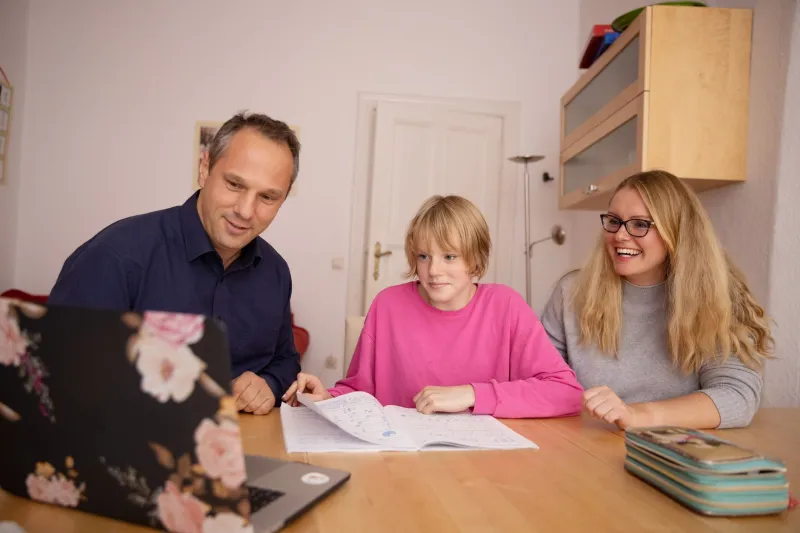
Consider creating a dedicated homework space. It need not be elaborate: a clear section of the kitchen table with good lighting and minimal clutter is perfectly sufficient. What matters is that your child associates that space with focused effort, and that you are nearby enough to offer reassurance without hovering.
Tackling Resistance to Reading
Reading at home is one of the most valuable things a child can do — and one of the activities most likely to provoke resistance. If your child groans at the sight of their reading book, you are not alone, and you have not failed.
First, it helps to understand why children resist. For some, it is fatigue — reading aloud after a full day of school is genuinely effortful. For others, there may be underlying anxieties about making mistakes, particularly if they feel they are being assessed rather than simply sharing a story.
A few strategies that work well for primary-aged children:
- Read together, not just to each other. Take turns reading paragraphs aloud, or read the same book simultaneously in companionable silence. This normalises reading as a shared activity rather than a performance.
- Follow your child's interests. If they are passionate about football, space, or animals, seek out books and magazines on those topics. The Reading Agency's Quick Reads initiative and local library services are excellent places to start.
- Resist the urge to correct every error. When a child mispronounces a word or skips a line, gently redirect rather than immediately correcting. Fluency builds confidence, and confidence builds fluency.
At Marton Primary, our teachers are always happy to recommend reading material matched to your child's current level and interests. Do not hesitate to ask at parents' evening or via the school office.
Addressing Maths Anxiety Without Dismissing It
Maths anxiety is a well-documented phenomenon that affects children and adults alike. If your child becomes visibly distressed when faced with number work at home, the worst response — however well-intentioned — is to say "it's easy" or "just try harder." This inadvertently communicates that their difficulty is a personal failing rather than a normal part of the learning process.
Instead, try the following approaches:
- Start with what they know. Before tackling a new concept, spend two minutes recapping something your child finds straightforward. This activates confidence and prepares the brain for challenge.
- Use real-world contexts. Measuring ingredients for a recipe, calculating change at the shops, or working out how many days until a birthday — these activities embed mathematical thinking in meaningful, low-stakes situations.
- Normalise mistakes. Share your own moments of confusion. "I always found fractions tricky too — let's work it out together" is a far more productive starting point than projecting anxiety or false certainty.
If you are concerned that your child's difficulties go beyond ordinary frustration, please speak to their class teacher. Our staff are trained to identify and support children who may benefit from additional input, and early conversations are always more helpful than delayed ones.
Supporting Independence Without Stepping Back Entirely
There is a delicate balance between supporting your child and doing the work for them. It is a balance that shifts depending on age, subject, and the child's current confidence level — and it is one that most parents navigate imperfectly, which is entirely fine.
As a general principle, aim to be a thinking partner rather than an answer provider. Questions such as "What do you think you need to do first?" or "Where in your reading book might you find a clue?" prompt children to activate their own problem-solving skills rather than waiting passively for a solution.
For older children in Years 5 and 6, gradually withdrawing your direct involvement — while remaining available — helps build the independent study habits they will need as they transition to secondary school. Encourage them to attempt tasks fully before seeking help, and praise the effort and reasoning process rather than simply the correct answer.
Working in Partnership With School
Marton Primary's approach to home learning is built on the understanding that parents and teachers are partners, not competitors, in a child's education. If homework tasks are consistently causing significant distress, or if you feel the volume or difficulty is not well matched to your child's current needs, please raise this with us directly.
Our teachers welcome feedback from families. A brief note in your child's reading record, a message via the school office, or a conversation at the classroom door can make a genuine difference to how we tailor support. We would far rather hear about a difficulty early than discover at the end of term that a child has been struggling in silence.
Learning at home, when it goes well, is not simply an extension of the school day — it is a space where children discover that they are capable, that effort leads to progress, and that the adults in their lives believe in them. That conviction, more than any worksheet or revision guide, is what truly inspires young minds.
For further guidance on supporting your child's learning at home, please visit the school website or speak to your child's class teacher.