Building Tomorrow's Thinkers: How Marton Primary Is Equipping Children for a World We Can't Yet Imagine
It is a striking thought: according to research from the World Economic Forum, a significant proportion of today's primary school children will eventually work in roles that do not yet exist. Artificial intelligence, green energy innovation, biotechnology, and industries we cannot currently name are reshaping the employment landscape at remarkable speed. For schools across the United Kingdom, this presents both a challenge and an extraordinary opportunity.
At Marton Primary School, we have taken that opportunity seriously. Rather than simply preparing children for the world as it is, our staff are committed to equipping pupils with the transferable skills, adaptive thinking, and creative confidence they will need to thrive in a world that is still being written.
Why the Traditional Curriculum Is Only Part of the Answer
The National Curriculum remains the foundation of everything we do at Marton Primary. Literacy, numeracy, science, and the humanities are essential building blocks — and we are proud of our pupils' achievements across all core subjects. However, our teaching staff have long recognised that subject knowledge alone is not sufficient preparation for the careers of tomorrow.
"When I started teaching, the idea that children might one day collaborate with artificial intelligence tools as part of their daily job felt like science fiction," says one of our Year 5 class teachers. "Now, it is simply the reality we are preparing them for. Our role has shifted. We are not just teaching content — we are teaching children how to learn, how to question, and how to adapt."
This philosophy underpins a growing number of initiatives at Marton Primary that sit alongside, and enrich, our standard curriculum delivery.
Digital Literacy: More Than Knowing How to Use a Screen
One of the most visible changes in our classrooms over recent years has been the integration of genuine digital literacy — not simply the ability to operate a device, but the capacity to think critically about technology, use it responsibly, and harness it creatively.
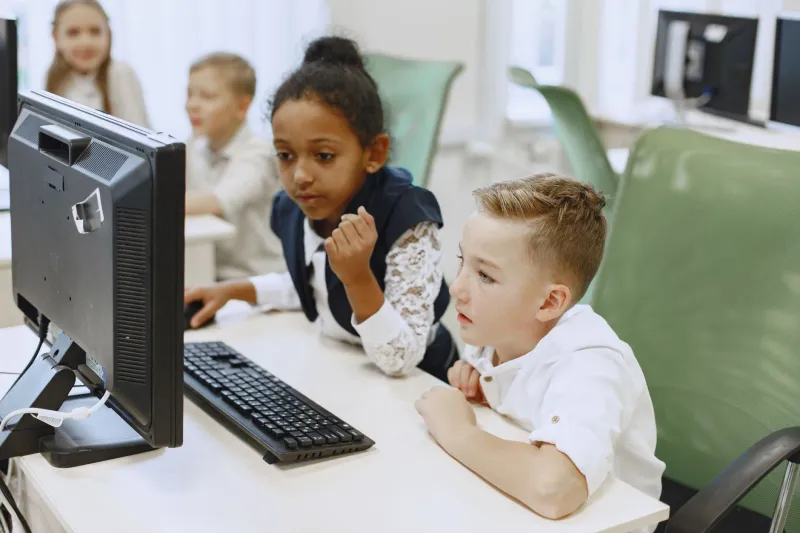
Our computing curriculum goes well beyond basic keyboard skills and internet safety, important as those remain. Pupils in Key Stage 2 are introduced to coding logic, data handling, and algorithmic thinking through age-appropriate projects that connect directly to real-world applications. A recent Year 4 project, for instance, challenged pupils to design a simple app prototype that could solve a problem in their local community. The results were imaginative, ranging from a litter-reporting tool to a digital noticeboard for village events.
"What struck me about that project was not the technical output," reflects our computing lead. "It was the conversations the children were having. They were thinking about users, about accessibility, about whether their idea would actually work in practice. That kind of systems thinking is enormously valuable, whatever career they eventually pursue."
Critical Thinking and the Art of Asking Better Questions
Across all year groups, Marton Primary has made a conscious effort to cultivate critical thinking as a daily habit rather than an occasional exercise. This means creating classroom environments where questioning is celebrated, where uncertainty is treated as a starting point rather than a problem, and where children are encouraged to evaluate evidence before forming conclusions.
Our approach to guided reading, for example, has evolved considerably. Rather than focusing exclusively on comprehension and vocabulary, teachers regularly prompt pupils to consider authorial intent, bias, and the difference between fact and opinion. These are skills that transfer directly to navigating an information-saturated world — one in which our children will need to distinguish reliable sources from misinformation with confidence and consistency.
Philosophy for Children (P4C) sessions, introduced across several year groups, have also proven particularly effective. In these structured discussions, pupils explore open-ended questions together — ethical dilemmas, abstract concepts, and real-world scenarios — learning to listen carefully, build on each other's ideas, and articulate their own thinking with clarity.
Creativity as a Core Competency
There is sometimes a tendency, in education policy discussions, to position creative subjects as a luxury — enriching, certainly, but secondary to the 'serious' business of core academic attainment. At Marton Primary, we firmly reject that framing.
Creativity — the ability to generate novel ideas, make unexpected connections, and approach problems from unconventional angles — is increasingly cited by employers and economists as one of the most valuable human attributes in an age of automation. Machines can process data and follow instructions with extraordinary efficiency. They are considerably less adept at imagining something entirely new.
Our arts, music, and design technology programmes are therefore not peripheral to our vision for pupils' futures — they are central to it. Collaborative projects that bring together STEM subjects and creative disciplines, sometimes referred to as STEAM approaches, are a regular feature of our curriculum planning. A recent science and art crossover project saw pupils studying light refraction before creating large-scale installations that demonstrated their findings visually. The project was not only memorable — it demanded both analytical rigour and imaginative expression in equal measure.
Resilience, Collaboration, and Learning from Failure
Perhaps the most fundamental shift in our approach to future-readiness is the emphasis we place on the process of learning, rather than simply its outcomes. In a rapidly changing world, the ability to encounter setbacks, reflect on what went wrong, and try again is arguably more valuable than any specific piece of knowledge.
Our growth mindset ethos, embedded throughout the school, encourages pupils to view challenges as opportunities rather than threats. Teachers are trained to praise effort and strategy rather than innate ability, and our assessment approaches are designed to give children meaningful feedback that helps them improve, rather than simply ranking their performance.
Collaborative working is equally prioritised. Group projects, peer review, and team challenges are woven into the fabric of school life at Marton Primary, reflecting the reality that virtually every professional environment — from the NHS to engineering firms to creative agencies — depends on people's ability to work constructively with others.
How Parents Can Support Future-Ready Learning at Home
The development of these skills does not need to stop at the school gates. There are many straightforward ways in which families can reinforce and extend this learning at home.
Encourage curiosity over answers. When your child asks a question, resist the urge to look up the answer immediately. Explore it together, discuss what you both think, and model the pleasure of not knowing — yet.
Embrace productive struggle. If your child finds a task difficult, offer encouragement and strategies rather than solutions. The experience of working through difficulty builds precisely the resilience that future employers will value.
Talk about technology critically. Rather than simply managing screen time, have conversations about what your child is watching, reading, or creating online. Ask who made it, why, and whether it can be trusted.
Celebrate creativity in all its forms. Whether your child enjoys drawing, building, storytelling, or inventing games, treat these activities as genuinely important — because they are.
Stay connected with school. Our regular parent information evenings, curriculum newsletters, and open classroom events are designed to keep you informed and involved. The more closely home and school work together, the more effectively we can support every child's development.
Looking Ahead
None of us can say with certainty what the world will look like when today's Year 1 pupils enter the workforce. What we can say, with considerable confidence, is that the children who will flourish in that world are those who can think flexibly, communicate clearly, collaborate generously, and approach the unknown with curiosity rather than anxiety.
At Marton Primary School, inspiring young minds every day is not merely a motto — it is a commitment that shapes every lesson plan, every classroom conversation, and every decision we make about how and what we teach. We are proud to be part of preparing our pupils not just for the tests ahead, but for the remarkable lives that follow.