Mud, Magnifying Glasses, and Maps: A Parent's Guide to Making the Outdoors Genuinely Irresistible
Here is a question worth sitting with: when did 'going outside' become something children need to be persuaded to do?
For most of human history, the outdoors was simply where life happened. Today, for many children, it is a place they visit reluctantly, between episodes of something more interesting. The standard parental response — limiting screens and pointing at the garden — rarely produces the enthusiastic outdoor explorer parents are hoping for. It produces, more often, a child standing at the back door looking aggrieved.
The problem is not the outdoors. The problem is that we have framed it as a consolation prize rather than a destination. Screens offer narrative, challenge, social connection, and immediate reward. If outdoor time is going to compete — and it absolutely can — it needs to offer the same things, in its own particular way.
This guide is not about reducing screen time through restriction. It is about making the outdoors so genuinely interesting that children begin to choose it.
Start With Curiosity, Not Fresh Air
The single most effective thing a parent can do to make outdoor time compelling is to approach it with genuine curiosity themselves. Children are exquisitely sensitive to adult enthusiasm. If you walk into the garden and say 'Right, off you go,' you are communicating that this is an obligation. If you crouch down beside a crack in the paving and say 'I wonder what lives in there,' you have started something entirely different.
Curiosity is contagious. You do not need to be a naturalist or an expert. You need only to be interested — and willing to say 'I don't know, let's find out,' which is, as it happens, one of the most educational phrases in the English language.
Ideas That Actually Work, by Age Group
For Children in Key Stage 1 (Ages 5–7)
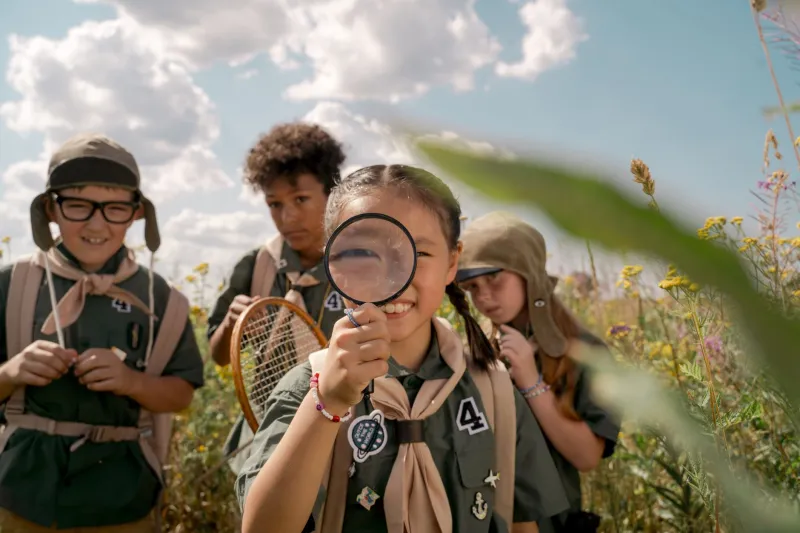
The Minibeast Hotel. Help your child build a bug hotel from stacked logs, bamboo canes, pine cones, and dry leaves. This is not merely a craft project — it is a long-term observation exercise. Once the hotel is built, the real engagement begins: who has moved in? What do they eat? Where do they go in winter? A magnifying glass and a notebook transform this into genuine scientific enquiry.
Mud Kitchen. A washing-up bowl, some old spoons, and access to soil and water is all that is required. Children at this age learn through sensory exploration, and mud kitchens support mathematical thinking (measuring, comparing quantities), language development (describing textures, smells, consistencies), and creative play simultaneously. The fact that it is also deeply enjoyable is, rather conveniently, the point.
Nature Colour Matching. Print or draw a simple colour palette — a range of greens, browns, yellows, greys — and challenge your child to find something in the garden or local park that matches each shade exactly. This activity sharpens observational skills and introduces children to the extraordinary variety of what initially appears uniform.
For Children in Lower Key Stage 2 (Ages 7–9)
Weather Journalling. Give your child a dedicated notebook and ask them to record the weather every day for a month — not just 'sunny' or 'rainy,' but cloud formations, wind direction (use a homemade wind vane), temperature estimates, and how the garden looks different under different conditions. By the end of the month, you have a genuine scientific record and a child who has learned to look at the sky rather than through it.
Map Making. Challenge your child to draw a map of your garden, local park, or a favourite walk — to scale, with a key, marked with features of interest. This connects directly to geography curriculum objectives whilst satisfying the deep human pleasure of representing a known space. Older children can progress to orienteering using free local maps downloaded from Ordnance Survey's Get Outside resources.
The Scavenger Hunt, Upgraded. Move beyond standard scavenger hunt lists. Instead of 'find something yellow,' try 'find evidence that an animal has been here,' 'find something that was alive last year but isn't now,' or 'find something that has changed since last week.' These prompts require inference, observation, and memory — considerably more demanding, and considerably more satisfying.
For Children in Upper Key Stage 2 (Ages 9–11)
Citizen Science Projects. The UK has a remarkable number of genuine scientific surveys that children can contribute to from their own gardens or local green spaces. The Royal Society for the Protection of Birds' Big Garden Birdwatch, the Woodland Trust's Nature's Calendar, and the Great British Bee Count are all free, accessible, and genuinely used by researchers. Children who understand that their data matters — that a scientist in an office somewhere will actually use what they record — engage with an entirely different quality of attention.
Gardening With Purpose. Growing food is one of the most reliably engaging outdoor activities for this age group, particularly when children have genuine ownership of the process. Give your child a raised bed, a container, or even a windowbox and let them decide what to grow, research the requirements, plan the planting schedule, and manage the project. The curriculum connections — to science, maths, geography, and even history (heritage varieties, food provenance) — are extensive.
Outdoor Sketching and Nature Journalling. This is distinct from art for art's sake. Encourage your child to sketch what they observe — a leaf, a spider's web, a cloud formation — with accompanying written notes: date, time, weather conditions, what they noticed, what they wondered. This practice, rooted in the tradition of great naturalists from Gilbert White to Charles Darwin, builds observational precision and a habit of recording that serves children across every subject.
Making It Stick: Three Principles
Follow the child's interest. A child who loves Minecraft will respond to landscape and terrain challenges. A child who loves cooking will be drawn to foraging, herb growing, and edible plant identification. A child who loves stories will engage with the history embedded in local green spaces, hedgerows, and field names. The content matters less than the connection to something they already care about.
Remove the pressure to perform. Outdoor learning is most effective when it is not assessed, graded, or compared. The moment a child senses that their enjoyment is being evaluated, the enjoyment diminishes. Be present, be curious, and resist the urge to turn every activity into a teachable moment. Some moments teach best when left alone.
Be consistent rather than ambitious. Twenty minutes in the garden three times a week is more developmentally valuable than a single spectacular day trip followed by weeks of screens. Regularity builds the habits of attention and observation that make the outdoors feel like a natural, comfortable space rather than an occasional event.
The Bigger Picture
At Marton Primary, outdoor learning is woven into our curriculum not because screens are bad, but because the physical world offers forms of learning that no screen can replicate: the weight of soil, the patience required to watch a caterpillar, the satisfaction of finding something unexpected in a familiar place. These experiences build the qualities — curiosity, persistence, attentiveness, wonder — that serve children throughout their education and beyond.
The goal is not to choose between the outdoors and technology. It is to ensure that children are fluent in both — and that they understand, through direct experience, what each has to offer. A child who can lose themselves in a digital world and also lose themselves in a real one is, we would argue, among the most fortunate of learners.